
The Workforce Risk Amid Geopolitical Constraint: Losing Access to Your Own Talent
In the Gulf region, tensions that escalated in February 2026 have not halted hiring activities; however, the process has become more protracted, selective, and contingent.
News
- AI Dispatch | AI’s Power Players Double Down
- Anthropic Joins Frontier, Signaling AI's Entry Into Carbon Removal Markets
- 42% of Middle East Employers Are Drowning in AI-Generated Job Applications, Survey Reveals
- SpaceX to Buy Cursor Parent Anysphere in $60 Billion Stock Deal
- Nvidia's Jensen Huang Wants a New Social Contract for AI
- OpenAI's Cash Burn and Shrinking Market Share Reflect a Maturing AI Industry

[Image source: ChetanJha/MITSMR Middle East]
In 2022, as U.S.-based space infrastructure company Momentus Inc. approached a $1.2 billion public listing, it ran into a problem that wasn’t technical, but geopolitical. Its founder, Mikhail Kokorich, the architect of much of its core technology, was legally barred from accessing it under U.S. national security rules.
Investors grew wary that the listing would face heightened scrutiny, not because the product was weak, but because a key leader could not legally perform core parts of his role. This was not a shortage of talent; it was a constraint on accessing it, shaped by geopolitics rather than capability.
The implications ran deeper. Leadership, in this case, was inseparable from technical knowledge, intellectual property, and strategic direction. As Quartz noted at the time, it is difficult to imagine SpaceX functioning effectively if Elon Musk were restricted from engaging with his own engineering systems. Yet this is precisely what geopolitical regulation can cause: a split between having the ability and having control.
The episode revealed a deeper fault line in the global innovation economy: when talent becomes a security risk, who really controls the technology?
The Momentus case is not an outlier. Across the global innovation economy, the same logic is playing out at scale: geopolitical regulation, data sovereignty rules, export controls, and national security legislation are introducing a new category of workforce risk. Not a shortage of talent, but a constraint on activating it. The measures organizations adopt to manage this risk can themselves become sources of risk if applied uniformly or without strategic clarity. What begins as prudence can evolve into latency. In sectors where competitive advantage is defined by speed of product launches, digital transformation, and AI deployment, latency is not neutral. It is a loss.
The concept of a borderless, globalized innovation economy begins to fracture when it encounters issues such as data sovereignty, export controls, and national security legislation, particularly in sectors where technology constitutes a critical asset. This pattern, characterized not by collapse but by constraints stemming from restricted access and delayed decision-making, is increasingly evident in workforce systems amidst ongoing geopolitical conflicts. In the Gulf region, tensions that escalated in February 2026 have not halted hiring activities; however, the process has become more protracted, selective, and contingent.
Organizations are not facing a shortage of talent; they are navigating a more conditional kind of access — who they can hire, how quickly they can onboard, and whether that talent can operate within regulatory and geopolitical limits. Roles remain open longer. Approvals take more time. Critical capabilities are harder to activate. In the Gulf, where tensions escalated in February 2026, this constraint is now structural.
Across the GCC, the pattern is familiar: during previous regional shocks, hiring shifted from expansion to consolidation, prioritizing critical roles and internal capability over new headcount. What distinguishes the current moment, says Sarah Brooks, Managing Director at Fikrah HR, is that the impact is uneven. “The regional impact across the GCC is not uniform; the geopolitical tensions have affected each of the members differently.” This asymmetry matters: organizations operating across multiple Gulf markets cannot apply a single workforce strategy and expect it to hold.
Employers are prioritizing essential roles, shifting toward flexible staffing models, and deferring long-term commitments. At the same time, demand for skills in AI, cybersecurity, and digital infrastructure continues to rise, even as companies struggle to secure talent quickly enough.
The Cost of Caution
The most visible impact of geopolitical instability on organizations is not layoffs; it is hesitation. Brooks characterizes the GCC as operating in a “two-speed” labor market: sectors exposed to discretionary spending — hospitality, traditional retail, logistics, and trade finance — are pausing or slowing non-essential hiring. Meanwhile, tech, healthcare, and government-linked infrastructure continue to recruit, underwritten by long-term national investment strategies that don’t pause for short-term volatility.
Technology occupies an ambiguous middle ground. Overall, tech hiring has softened from earlier peaks, and cycles have lengthened. But demand for technology that enables risk management, digital transformation, AI, and cybersecurity remains resilient — precisely because those capabilities are now operational necessities, rather than strategic aspirations.
This creates a structural imbalance: the skills organizations need most to navigate uncertainty are now the hardest to hire quickly. The result is a slowdown in execution.
She points out that some firms are overcorrecting their strategies. “The instinct to tighten is understandable, but we’ve watched companies cut contingent headcount aggressively in one quarter and then re-engage the same talent at a premium six months later when conditions stabilized,” she adds. That overcorrection ends up costing more than the caution was meant to save.
This pattern is reinforced across the broader MENA region. As Pedro Lacerda, Senior Vice President, TASC Outsourcing, observes, “Hiring hasn’t stopped, but the character of it has changed.” In markets like the UAE and Saudi Arabia, recruitment pipelines remain active, supported by national workforce programs and large-scale infrastructure investments. “What has shifted is the scrutiny,” he explains.
“Clients are prioritizing roles that tie directly to revenue or operational continuity, and discretionary headcount second hires for new functions, “nice-to-have” roles, get pushed to the next quarter.” The distinction between essential and non-essential roles becomes sharper — and more consequential — under pressure.
Sectoral dynamics further illustrate this divide. Lacerda points out that “technology, healthcare, and government-linked infrastructure remain the strongest,” underpinned by long-term national investment strategies that do not pause amid short-term volatility. Logistics, too, has become more resilient as supply chain stability moves from a strategic aspiration to an operational necessity. Meanwhile, consumer-facing sectors tighten first, responding to dips in consumer confidence by slowing hiring before cutting roles altogether. The outcome is a bifurcated labor market where resilience and retrenchment coexist.
Brooks describes this as “slowing the tempo and tightening the criteria”. At the same time, firms are shifting toward “contract, project-based, and interim roles to preserve flexibility while keeping critical projects moving,” alongside increased reliance on redeployment and the upskilling of existing staff. Workforce planning itself is becoming more dynamic, with organizations modeling “pause, proceed, and accelerate” scenarios as geopolitical and macroeconomic conditions evolve.
The instinct to consolidate is understandable. But consolidation has a compounding cost. The longer approval cycles stretch, the more hiring decisions decouple from business timing. The more organizations lean on internal redeployment, the greater the risk of overextending existing teams. The more discretionary roles are deferred, the thinner innovation pipelines become. Caution, applied uniformly, becomes a slow drain on execution capacity.
Taken together, these adjustments amount to what Brooks calls “disciplined optimization” — a deliberate effort to prioritize essential roles, defer noncritical hires, and build internal resilience. But discipline, in this context, carries a hidden cost. The longer approval cycles stretch, the more hiring decisions become decoupled from business timing. The more organizations rely on internal redeployment, the greater the risk of overextending existing teams. And the more discretionary roles are deferred, the thinner innovation pipelines become.
This is the paradox of being cautious in conflict economies. The measures organizations adopt to reduce risk can themselves become sources of risk if applied uniformly or without strategic clarity. What begins as prudence can evolve into latency. And in sectors where competitive advantage is defined by speed —product launches, digital transformation, AI deployment — latency is not neutral. It is a loss.
The cost of caution, then, is not simply delayed hiring. It is the gradual erosion of alignment between workforce capability and strategic intent. Organizations continue to function, projects continue to move, and hiring continues at a measured pace. But beneath that surface stability, the system begins to lag. Decisions arrive later than opportunities. Talent arrives after demand peaks. And by the time uncertainty clears, the competitive landscape has already shifted.
In conflict economies, the question is not whether to be cautious. It is the amount of caution the organization can absorb before it begins to lose momentum.
Designing the Adaptive Core
If caution is the dominant instinct in conflict economies, design must become the counterbalance. The organizations navigating this best are moving from reactive workforce planning to something more deliberate: a workforce architecture built for conditional access.
The model has three layers. A stable core of mission-critical roles — revenue-generating, operationally essential — that never pauses. A flex layer of contract and project-based talent that can scale without permanent headcount commitment. And a fluid capability layer, built through active redeployment and upskilling, that allows internal mobility when external hiring slows, or approval cycles stretch. The goal is not efficiency. It is continuity under constraint.
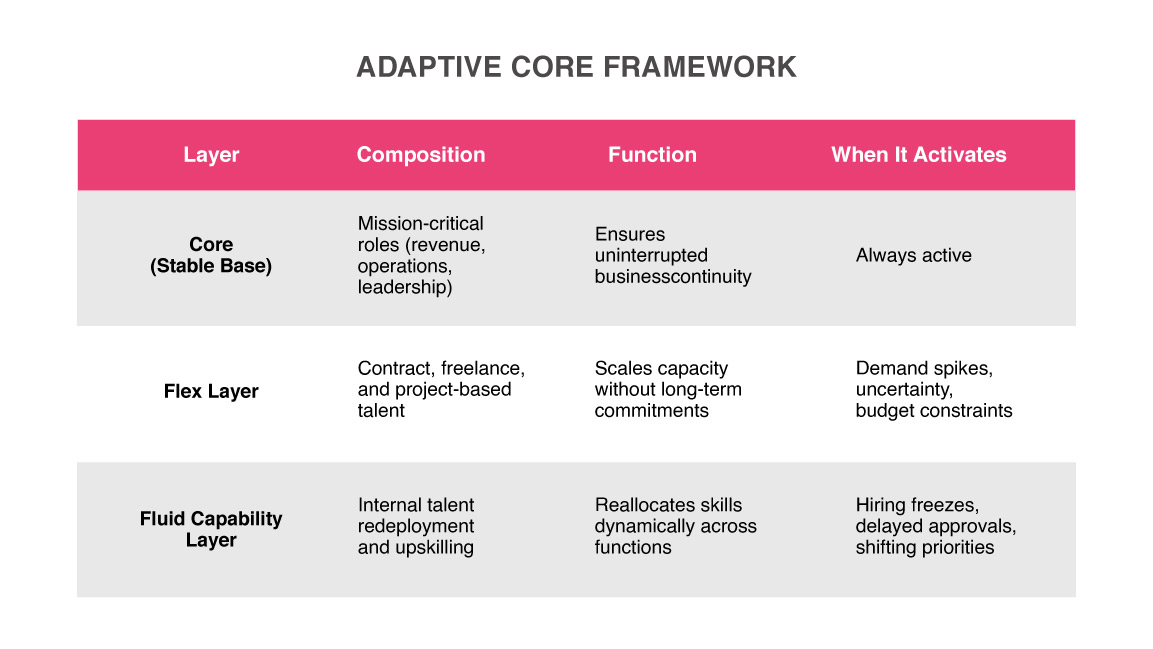
Designing an adaptive core is only half the task. The harder challenge is governing it — deciding in real time how much caution the organization can absorb without slowing execution.
For the C-suite, this means setting a clear workforce risk posture and resisting the instinct to apply uniform restraint. The strategic task, therefore, is not simply to slow hiring but to avoid decisions that create future capability gaps or higher rebuilding costs.
For functional leaders, particularly HR and business unit heads, the challenge is to translate that posture into a system that balances flexibility with continuity. This requires maintaining access to talent even when hiring slows. As Lacerda notes, “The smarter approach is to maintain a flexible core — keep your critical talent pipelines warm and your outsourced workforce relationships active, so you’re not rebuilding from scratch when demand returns.” At the same time, workforce design must reflect how structural instability is changing. The emphasis shifts from filling roles to sustaining capability.
At the board level, the responsibility is to ensure that this optimization does not become erosion. Workforce shifts today are often subtle, manifesting as longer hiring cycles, selective approvals, and quiet reprioritization. These changes may not immediately affect financial performance, but they reshape execution capacity over time. Boards must therefore treat workforce composition as a strategic variable, asking where flexibility strengthens resilience and where it quietly dilutes core capability.
The lesson from Momentus Space is not just about one IPO or a single regulatory rule. It shows how workforce risk is being redefined. The company did not lose its technology, its market, or its leadership; it lost the ability to use that leadership fully when it mattered most.
In today’s conflict-shaped economies, that constraint is playing out across organizations at every level — more quietly, but no less consequentially. Talent exists. Roles are approved. Strategies are intact. But access is conditional, execution is delayed, and capability is harder to activate precisely when it is needed most. The imperative for leadership is no longer simply to secure talent. It is to build workforce systems resilient enough to function under geopolitical limits on access, speed, and control. In the Momentus case, the company had everything it needed except the ability to use it. That is the risk every organization in a conflict-shaped economy now carries.