



What Happens When AI Becomes Fluent in Your Business
AI-powered systems can analyze workflows and optimize operations. But here’s how they translate complex data into insights that drive measurable business impact.
News
- Talent Boomerang: Mira Murati’s Thinking Machines Loses Two Co-Founders to OpenAI
- YouTube Allows Parents to Limit Kids’ Shorts Viewing Time
- What Scott Adams' Dilbert Got Right About Power at Work
- Salesforce Rolls Out Slackbot as an AI Agent
- Zoho Launches First Middle East Data Centers in UAE
- Apple Bets on Google’s Gemini to Anchor Its AI Future
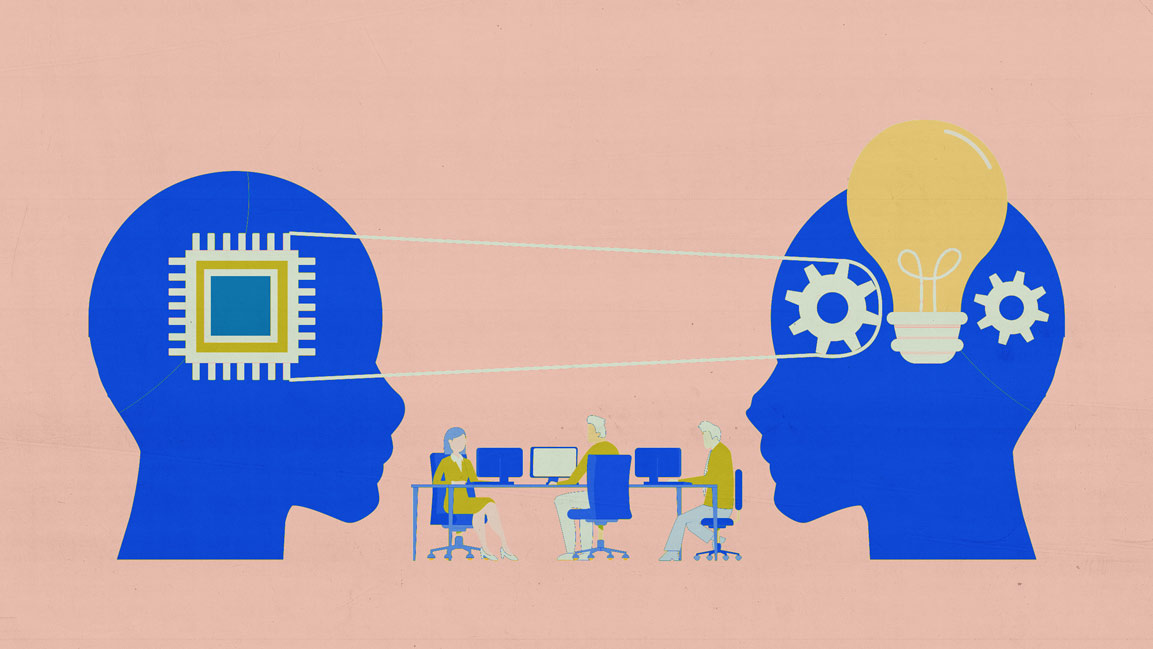
[Image source: Chetan Jha/MITSMR Middle East]
Personalization has quietly become the default logic of the consumer internet—so embedded that it is rarely noticed. The right product at the right time, every time. Search results anticipate intent, recommendations narrow choice, and relevance is assumed. That same design principle is now moving decisively into the enterprise.
“AI now allows every business to operate as its own Segment of One, designed around its unique processes, needs, and goals,” said Khalid Murshed, CEO, e& enterprise, and Harrison Lung, Group Chief Strategy Officer, e&, in a joint statement. “To see why this is both possible and necessary, we need to look at the limitations of the tools enterprises have relied on so far.”
The Limitations of Traditional Enterprise Software
Historically, enterprises have relied on two approaches: Commercial Off-The-Shelf (COTS) solutions or customized add-ons. While these tools offered incremental improvements, they rarely captured the full complexity of modern organizations.
“COTS is designed for speed and scalability, but it’s often the rigid ‘one-size-fits-all’ software that doesn’t meet the specific needs of individual businesses. Even in the best cases, off-the-shelf solutions meet around 80% of requirements and still require sizeable integration work,” Murshed and Lung explained.
Custom-built extensions can bridge some gaps, but they add cost, complexity, and technical debt. “Most CTOs will acknowledge that enterprises often end up modifying 10–30% of the code just to make a solution fit their processes, which may only improve short-term alignment,” they added.
These limitations are evident in wider enterprise adoption patterns, where up to 53% of SaaS licenses remain unused, and CRM deployments frequently fall short of expectations. According to Colby’s 2025 analysis, the average CRM user adoption rate is around 26%, while nearly half of sales leaders report that their CRM does not fully meet their teams’ needs.
Moving Beyond Incremental Change
AI offers a fundamentally different path. Instead of forcing teams to adjust to rigid software, AI systems learn how a business operates and adapt workflows, processes, and tools accordingly.
“AI can absorb operational data and workflow patterns and create configuration paths that are built around the organization’s uniqueness,” the duo explained. “With AI agents and adaptive systems, businesses no longer must choose between scalability and specificity.”
Think of how Google Search tailors every result to individual users. AI is doing the same for enterprises. It interprets data structures, maps dependencies, and identifies integration requirements with precision, shortening deployment timelines while aligning systems with real business needs.
“Once systems are in place, AI agents continue to observe behavior inside the organization. They capture friction points, approval paths, process bottlenecks, and interaction patterns across teams. They then refine interfaces, suggest alternative routes, or automate recurring steps,” they added. Insights gained across various environments reinforce the core models, while client-specific data ensures that each deployment remains unique.
Real-World Impact Across Industries
The applications are tangible across sectors. In telecommunications, an Asian operator used AI-driven recommendation engines to personalize offers for over 25 million prepaid users, resulting in increased acceptance rates, higher average revenue per user (ARPU), and reduced churn.
A MENA-based telco applied AI-powered sentiment and network-influence analysis to detect key opinion clusters, optimizing campaigns and lowering acquisition costs. In financial services, a regional bank leveraged machine-learning models to identify “hidden affluent” segments, enabling targeted product strategies and higher relationship value.
“Across industries, AI-driven personalization is proving its ability to unlock measurable growth, efficiency, and customer value,” Murshed and Lung explained. “The foundation is the same: AI systems built as adaptable, enterprise-grade frameworks that evolve with each client’s needs.”
e& enterprise’s own industry-specific AI platforms reflect this philosophy. In banking, AI supports sales funnel estimation, hidden-affluent identification, churn prediction, fraud detection, credit scoring, and wealth-management insights.
In retail, AI enhances supplier selection, demand forecasting, dynamic pricing, and hyper-personalized merchandising strategies.
“Our approach at e& enterprise echoes with industry-specific platforms that combine domain expertise with adaptive intelligence,” they noted. “Each solution is purpose-built for context, scale, and trust—showing what it means for modern enterprises to operate as a true Segment of One.”
The Future of Enterprise Technology
The stakes are significant. IDC forecasts that worldwide enterprise applications revenue will exceed $600 billion by 2028, while organizations are pouring billions more into custom software, projected to surpass $860 billion by 2030. Meanwhile, the market for enterprise AI solutions is expected to grow from approximately $21 billion in 2025 to over $560 billion by 2034.
“Enterprises are moving from passive users of generic tools to architects of their own systems,” say Murshed and Lung. “With AI-driven personalization, organizations get the agility, efficiency, and innovation that emerges from technology designed around their needs.”
“In the age of AI, the most powerful enterprise is the one built unapologetically around itself. The Segment of One model isn’t just a consumer concept anymore—it’s the blueprint for the modern enterprise,” they concluded.