What to Read Next
- Bridge the Intergenerational Leadership Gap
- Enterprises Are Scaling AI Faster Than They Can Govern It: Study
- As AI Agents Proliferate, Identity Security Gaps Persist, Report Finds
- Meta Found Liable in Child Exploitation Trial; Penalized $375M
- The Gulf’s Toughest Test of Recovery: Conflict, Supply Chains, and the New Geography of Risk
- OpenAI Flags Microsoft as a ‘Risk Factor’ Ahead of Potential IPO, Report Says
The telco-to-techno shift is no longer optional. It is an operational necessity in a world where connectivity, cloud, and AI are deeply intertwined.
Telecom operators across the Middle East are at a critical turning point. Offering basic connectivity is no longer sufficient; networks must now evolve into intelligent, cloud-native platforms that can support new digital ecosystems.
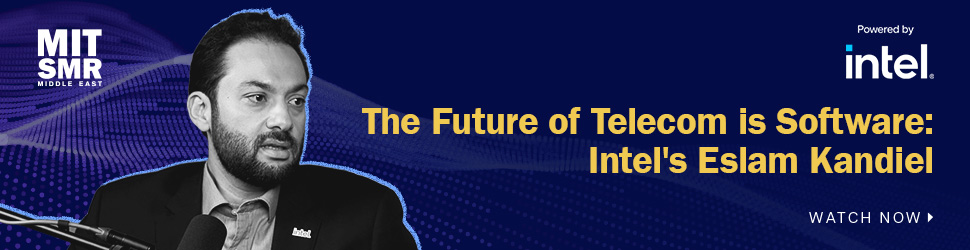
Eslam Kandiel, Telco Key Account Director at Intel, emphasizes that “telecom networks are completely different from what they were 10 years ago,” highlighting the rapid innovations over the past decade.
What is unfolding is a structural reinvention of the telecom industry’s architecture, economics, and role in the digital value chain.
A Decade of Foundational Change
The transformation of telecom networks emerged from the convergence of several pivotal innovations. Kandiel says, “During the last 10 years, we saw a lot of technology trends come together,” including network functions virtualization (NFV), software-defined networking (SDN), advances in compute power, and the 5G rollout.
These developments have shifted telecom infrastructure from fixed, hardware-based systems to flexible, software-defined ones. Today’s networks, he says, can “run as a software, similar to an IT application,” enabling automation, programmability, and faster innovation.
Telecom networks, however, differ from traditional IT systems. Kandiel points out that they “require different types of security and performance,” highlighting how tricky it is to balance that flexibility with carrier-grade reliability.
At the same time, this architectural shift has unlocked entirely new capabilities. As Kandiel notes, operators can now “offer different types of services, like edge computing and network slicing,” which are increasingly becoming standard tools in the operator toolkit.
Cloud as Strategy
As networks become software-centric, cloud adoption has become a strategic imperative. However, the real challenge lies not in choosing one model over another, but in orchestrating multiple environments effectively.
Reflecting on Intel’s 2021 research, Kandiel explains that operators were trying to answer a fundamental question: “Which cloud infrastructure to use for which workload?” The answer required evaluating performance, security, latency, and sovereignty.
The conclusion remains highly relevant today: “Diversification of using cloud is not a choice, it’s an optimization itself.”
He elaborates, “Some workloads are better kept under full control within a vertically integrated cloud infrastructure,” while “others are better shared on a horizontally integrated cloud infrastructure.” At the same time, “some workloads on the public cloud may provide agility, faster time to market, and faster changes.”
While this multi-cloud approach introduces complexity, its value is clear. Kandiel emphasizes that it “definitely provided a lot of flexibility and agility to operators to keep up with the demand,” particularly during periods of rapid digital acceleration.
AI as Catalyst
Artificial intelligence is now accelerating this transformation. Kandiel states that today all operators are eager to adopt AI, highlighting its potential to enhance operational efficiency and performance.
The opportunity extends beyond internal optimization. “Other operators also want to offer it as a service,” he adds, signaling a shift toward AI-driven revenue streams.
This dual use case reinforces the importance of infrastructure flexibility. Kandiel explains that the use of various cloud and data center services becomes a matter of optimization tailored to each operator’s specific goals.
Intel’s role in this ecosystem is to enable choice. “The most important thing for operators is to have the freedom of choice,” he says, adding that deployment decisions ultimately depend on “the need for performance, latency, and customer demand for the service.”
The Rise of the Techno Operator
Beyond infrastructure, the most profound shift is taking place at the business-model level. The “telco-to-techno” transformation redefines what telecom operators are and what they offer.
“This is one of the most fundamental changes that impacts the business model of the telecom operator,” Kandiel explains.
In the past, operators focused on voice and connectivity. Today, those services are expected, yet no longer sufficient for differentiation. Kandiel says, “This is challenging today’s operator business model.”
Operators are diversifying in response, with many “smart moves happening through the combination of connectivity and other services customers are demanding.” This includes offerings where “IoT is a device plus connectivity,” as well as financial and security services that integrate connectivity to applications.
Ultimately, the transformation is about integration. Kandiel says it means “combining their core strength, which is connectivity, with other technology capabilities to provide a new offering to customers.”
Ecosystem Innovation
This transformation is already materializing in real-world deployments. Kandiel highlights emerging AI solutions that combine infrastructure, software, and connectivity into unified offerings.
One example involves small language models. He explains, “We don’t really need a large language model; maybe we need multiple small language models,” which can be deployed efficiently and tailored to specific use cases.
These models, delivered through cloud environments and integrated with telecom services, are already gaining traction. Kandiel notes there is “very positive traction in the market for this,” indicating strong enterprise demand.
Another area of innovation lies in AI-enabled devices. Kandiel describes ongoing work where “we are developing an AI PC offering that has the capability of a small language model within the PC itself, enabling use cases across enterprise functions such as legal, finance, and HR, as well as education.”
These examples demonstrate how operators are moving beyond connectivity to deliver integrated, value-added solutions.
The Middle East Advantage
The Middle East stands out as a leader in this transformation, driven by both ambition and execution. Kandiel attributes this to the region’s strategic alignment between national vision and operator innovation.
Operators are “playing a major role in achieving the overall strategy of the country,” particularly through offerings such as AI, cloud, and security services. He emphasizes their pace of change: “They are transforming very fast, and show clear agility.”
More importantly, they are redefining their role within the digital ecosystem.
Rather than competing with digital-native players, operators are working with them. “We are not going to compete with the OTTs,” Kandiel says. “We are going to integrate OTT solutions and become the agent of the transformation.”
This positioning allows operators to remain central to the digital economy while expanding their value proposition.
AI-Native Networks and Autonomous Demand
Looking ahead, telecom networks will need to support an entirely new class of users: AI agents. “We will see AI agents talking not just to humans, but to each other as well,” Kandiel predicts. These interactions will come with “very strict SLA measurements,” fundamentally changing how network performance is evaluated.
This change will demand quicker implementation of AI-driven processes. He said that operators need to facilitate “faster adoption of new technologies and increased use of AI support that enhances network management by operators.”
Leadership Over Technology
Amid this technological change, Kandiel emphasizes that leadership remains the ultimate differentiator. “Technology will keep shifting,” he says, but success depends on “the essence of leadership [and] how leaders are able to create a culture of innovation.”
This includes not only generating ideas but executing them effectively. True innovation, he explains, lies in “adopting these ideas and transforming them into a business that creates a revenue stream.”
Operators must also be selective. “You don’t need to chase trends,” Kandiel advises. Instead, “you need to be a very strategic selector,” staying focused while accelerating execution.
The telco-to-techno shift is no longer optional. It is an operational necessity in a world where connectivity, cloud, and AI are deeply intertwined.
As Kandiel points out, operators must keep “moving from one technology to another faster,” while adapting to new customer needs and service demands.
In this new era, success will not be defined by technology alone, but by the ability to integrate, optimize, and innovate continuously. The transformation is already underway, and those who embrace it will define the future of digital infrastructure.