What It Takes to Be Careem
How Careem used technology and vision to become one of the region’s leading movers of people, goods, and money.
Topics
News
- AIRF Dubai 2026 Will Put Agentic AI Execution in the Spotlight
- UAE Companies Expand Recruitment for AI Talent Despite Global Headwinds
- Qatar Launches Global Alliance for AI Ethics at UN AI Governance Dialogue
- UAE AI Minister Pushes for Guardrails to Keep AI From Becoming 'Tyrannical'
- AI Productivity Gains Have Yet to Spread Beyond the Technology Sector: Analysis
- Abu Dhabi Expands AI Drive, Deploys Copilot to 35,000 Civil Servants

Key Takeaways
01
Super apps succeed when in markets where daily frictions remain unresolved, and no dominant incumbent controls the stack.
02
Purpose can function as a competitive moat in emerging markets. In volatile or trust-deficient markets, social legitimacy can become a strategic asset as valuable as capital or scale.
03
Successful M&A depends less on acquiring promising businesses and more on whether the parent organization is structurally prepared to absorb them technologically, culturally, and operationally.
04
The rise of the “Careem Mafia” — former employees launching hundreds of startups across the region — demonstrates how entrepreneurial cultures can create long-term ecosystem influence beyond the firm itself.
Usually, when regional companies are acquired by a global behemoth, they fade into the background — absorbed, rebranded, or quietly sidelined. Careem, however, has done the opposite. Five years after Uber acquired a majority stake in the Dubai-based firm, Careem continues to operate as one of the region’s most ambitious technology companies — a rare feat in today’s hyper-competitive super-app race.
What makes this persistence strategically relevant is not longevity, but control. Most post-acquisition companies lose product autonomy, capital discipline, and market identity. Careem has retained all three, suggesting that in emerging markets, acquisitions do not necessarily dilute strategy; under certain conditions, they can extend it.
The underlying logic is economic. Mobility delivers frequency, but thin margins; logistics and delivery introduce higher basket sizes and monetization layers. The super-app model only holds if adjacent services expand lifetime value faster than they increase operational complexity.
Abhishek Rajput, Senior Engagement Manager at Redseer Strategy Consultants, notes: “Careem’s journey has been a powerful example of a Middle Eastern startup. It has shown how a local tech company can succeed across multiple geographies, emerging as one of the most cited examples of the GCC startup ecosystem.”
Bamboo Shoots
It all began in 2012, under the code name Project Bamboo. The idea was straightforward — identify daily challenges and find opportunities in them. “Every problem is an opportunity,” Mudassir Sheikha, CEO of Careem, recalls. “The bigger the problem, the bigger the opportunity.”
In practice, this translated into a focus on high-friction, under-served daily use cases, a pattern that would later define the startup’s expansion logic.
Initially a website for corporate car bookings, Careem quickly evolved into a ride-hailing company serving everyday commuters. The name was a happy accident. Careem, in Arabic, means “to be generous,” and Careem.com was available. That philosophy of generosity, toward customers, captains, and colleagues, became part of the organization’s DNA.
“Careem’s journey has been a powerful example of a Middle Eastern startup. It has shown how a local tech company can succeed across multiple geographies, emerging as one of the most cited examples of the GCC startup ecosystem.”
— Abhishek Rajput, Senior Engagement Manager at Redseer Strategy Consultants
Respecting its drivers — or “captains,” as they’re called — was central from the very beginning. In the early days, co-founder Magnus Olsson personally conducted interviews in a parking lot in Dubai’s International City. “We showed them respect,” he says. “And they built Careem together with us.”
The Super (App) Vision
Long before the term “super app” became a thing in the technology industry, Careem had already spotted the shift. By 2017, COO Adeeb Warsi had said that it was clear the company had to expand into adjacent markets.
This was not diversification for growth, but adjacency-led consolidation — expanding only into services that reduced user acquisition costs or increased engagement within an existing base platform.
The company began adding services that addressed daily needs — food delivery, groceries, bill payments, remittances, and even bike-sharing. When COVID-19 lockdowns hit in 2020, and mobility froze, Careem used the crisis to reinvent itself. By mid-2020, it had merged all its services into a single app, creating a unified digital ecosystem.
Usually, the principal motivation for becoming a superapp is to expand revenue streams, thereby increasing a platform’s profitability and diversifying its income sources. The strategy of risk smoothing helps the business across cycles. Mobility demand is elastic; payments and delivery introduce more stable, repeat transactions. Together, they create a more resilient revenue base.
As Michael Greenwood of Juniper Research notes, any brand aiming to evolve a specialized app into a superapp needs to prioritize modular design. That makes it far easier to layer in new services over time. One practical approach is to build on a third-party platform rather than assembling an in-house development team. This reduces costs while leveraging the platform provider’s technical expertise.
That said, the decision carries significant long-term implications: once a platform is selected, future expansion becomes tied to its capabilities, making the wrong choice a potential constraint on growth. After launch, the focus shifts to scaling by growing the user base, entering new markets, and broadening services.
Between 2012 and 2017, Careem prioritized geographic expansion across 10 countries while keeping its product tightly centered on ride-hailing. This focus helped build trust, making it easier later to introduce additional services to an already engaged user base.
Payments are typically central to superapps, enabling seamless in-app transactions. Careem entered this space with Careem Pay, initially a closed-loop peer-to-peer transfer system. By 2020, it had evolved into an open-loop wallet, allowing broader payments and withdrawals. In 2023, the company began offering remittance services, starting with the UAE–Pakistan corridor, while recognizing that many of its drivers were migrants who regularly sent earnings back home. In markets with large migrant populations, payments are an entry point into daily financial behavior, concretizing the ecosystem more deeply than mobility does.
Yet this exposure also introduces macroeconomic risks. In 2025, Careem exited Pakistan after a decade of operations, citing currency volatility and declining economic viability, highlighting that scale in emerging markets amplifies exposure to instability rather than insulating against it.
Beyond the immediate outcome, the experience highlighted two broader lessons:
1) Successful superapps are built on a deep understanding of user behavior.
2) New features work best when they complement existing services. In emerging markets, early entry secures position but not permanence.
However, this strategy also has limits: focusing too heavily on existing users can constrain the ability to attract entirely new customer segments.
“After COVID, they likely recognized the need to move beyond ride-hailing. That business had taken them from 1 to 10 — but the journey from 10 to 100 required a different model.”
— Abhishek Rajput, Senior Engagement Manager at Redseer Strategy Consultants
“When Uber acquired it, it became one of the most talked-about M&A deals in the region — the first transaction of that scale,” says Rajput. “After COVID, they likely recognized the need to move beyond ride-hailing. That business had taken them from 1 to 10 — but the journey from 10 to 100 required a different model. The result was a pivot toward becoming an everyday convenience platform, expanding into a wide range of services and entering new markets beyond their original footprint,” he adds.
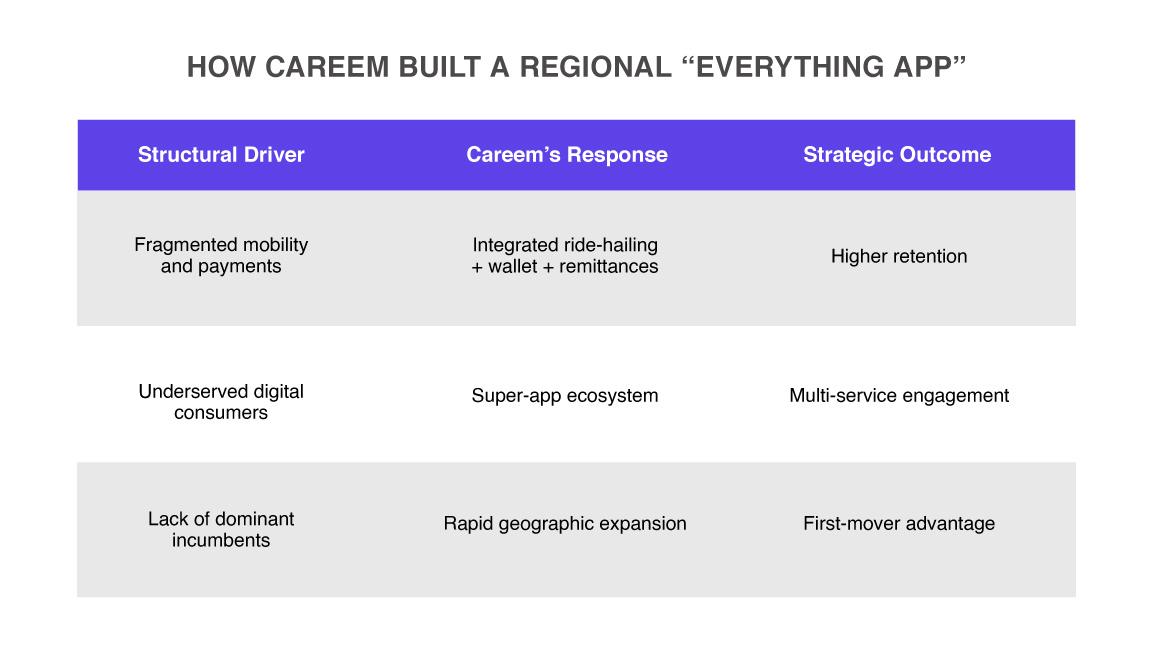
The team saw a chance to build the “everything app” based on three clear market signals. “First, there were so many daily frictions in the region that could be solved with digital services. Second, and perhaps most crucially, unlike in other global markets, no dominant player was offering the full convenience and value of an integrated everything app. Finally, with a fast-growing, digital-first population, we knew the demand for a seamless, all-in-one platform was only going to accelerate,” Bassel Alnahlaoui, Careem’s Chief Business Officer, notes.
“The real litmus test, of course, was whether customers truly wanted this,” Alnahlaoui adds. The Careem Plus subscription with an active base of 570,000 users validates this. It ties the ecosystem together, with members saving an average of more than AED 300 per month and active users saving more than AED 1,000 per month.
Many global companies trying to become super apps have struggled to keep users across different services. Elon Musk’s X, aiming to be an “everything app,” has tried payments, commerce, and financial services but hasn’t shown use beyond its social feed. Uber expanded into food delivery, freight, bikes, and financial services, but users mostly use each service separately. PayPal relaunched as a super app with savings, crypto, shopping, and bill payment, but adoption outside payments has been uneven. Meta added payments, marketplace, and commerce to Facebook and WhatsApp, but Western users haven’t embraced an all-in-one platform.
Unlike the Asian leader WeChat, many attempts to keep users across multiple services have failed.
“They were able to figure out one of the biggest problems in the region for payments, which was remittances. In terms of transactions, they handle approximately 100,000 per day. But the margin of the payment business is much less compared to other verticals,” says Rajput.
So how did Careem keep its ecosystem uncluttered? “We started with customer needs as our North Star, while balancing the business,” Alnahlaoui says.
The pattern is structural. Many Western super-app attempts failed not due to execution but because they lacked the underlying unmet daily frictions that make integration valuable rather than redundant.
First-Mover Disadvantage
Being early imposed distinct operational and strategic burdens on Careem that later entrants could avoid.
The most immediate challenge was creating the market itself. Unlike in mature ecosystems, Careem was not entering an existing category; it was building one. This meant investing heavily in consumer trust, driver onboarding, and behavioral change before scale economics could take hold.
On the supply side, the company had to construct and stabilize a labor force from largely informal markets. Periodic labor actions in markets such as Jordan exposed a deeper issue: platform scalability often outpaces labor governance.
Regulation presented a parallel constraint. As a first mover, Careem operated in policy vacuums, forcing it to engage directly with governments to define the rules of the category. While this created early influence, it also meant absorbing compliance uncertainty and political risk.
Built on Purpose
Careem’s founders didn’t begin with a business plan; they started with a calling. Olsson had just recovered from brain surgery and was searching for a renewed sense of purpose, while Sheikha was looking to move beyond consulting into something “big and meaningful.”
Those two words recur often in conversations about Careem. They’ve also defined the company’s evolution: from enabling women in Saudi Arabia to drive for the first time, to launching in Palestine as part of a promise to create one million jobs across the region.
In 2017, Careem launched the Careem Women Empowerment and Engagement Network (CWEEN) to promote women in leadership. By 2018, women made up 80% of its customer base in Saudi Arabia — a statistic that underscored the firm’s ability to align social change with business growth.
When Saudi Arabia lifted its driving ban in June 2018, Careem was uniquely positioned to onboard female drivers immediately — a first-mover advantage built not through competitive intelligence but through trust capital accumulated years earlier. This is purpose-led market positioning: the deliberate alignment of organizational values with underserved segments in ways that create a durable competitive advantage competitors cannot quickly replicate.
The app provides over 20 digital services to help people move around, order things, manage payments, and organize other aspects of their lives.
For captains and partners, “meaningful” translates into steady earning opportunities.
The company’s roots and purpose are consistently evident in its actions. For example, during Ramadan, it introduced tip matching, doubling customer tips for delivery and ride captains nationwide in the UAE, including Hala Taxi captains on the Careem platform.
In late February, as Iran started targeting the UAE amid increasing geopolitical tensions, Careem took proactive measures. The company began monitoring the regions it services in real time to protect its captains’ safety and paused operations whenever authorities issued warnings.
“Despite facing challenges, we remain committed to ensuring supply chain and service continuity. To handle increasing demand, our distribution network operates with planned buffer capacity and diversified sourcing strategies to manage volatility,” the company said.
Through various campaigns, the company is effectively responding to evolving purchasing habits. As part of the ‘This is Home’ initiative, Careem Food provides free delivery from over 400 local UAE restaurants. Additionally, in Abu Dhabi, Careem is waiving commission fees for new local restaurants on the platform for 3 months to help reduce their costs.
Careem Quik, meanwhile, delivers the finest products made and grown in the UAE directly to customers’ doors, with an option to donate to Lebanon through a partnership with the World Food Program.
Purpose here functions as a form of market access strategy, enabling entry into segments that competitors — particularly global competitors — are slower or less equipped to serve.
Finance and Forays
Over the years, Careem has grown through a mix of acquisitions and innovation. It acquired the Saudi-based delivery startup Enwani in 2015, the food-delivery startup RoundMenu in 2018, and the bike-sharing platform Cyacle in 2019. It launched Careem Pay in 2022 — a digital wallet that now enables remittances between the UAE, Pakistan, and India, with a 77% user retention rate.
“Rather than keeping acquisitions at arm’s length, we embed them into shared infrastructure, loyalty mechanics, and design language.”
— Bassel Alnahlaoui, Careem’s Chief Business Officer
In a bold move, Careem even started delivering 24-carat gold coins in 2025, coinciding with the Indian festival of Akshaya Tritiya.
Careem has built a track record of integrating acquired businesses into its ecosystem—both culturally and technologically. “Rather than keeping acquisitions at arm’s length, we embed them into shared infrastructure, loyalty mechanics, and design language,” Alnahlaoui says.
Two examples are Careem Bike, which transitioned from a standalone app to a fully integrated super-app experience, and Careem Pay Remittances, which has become a cornerstone of the company’s fintech strategy. In both cases, integration unlocked strategic value that wouldn’t have been possible as standalone businesses.
Tech That Drivers
The team’s crystal-clear mission is to simplify and improve people’s lives, saving time when every second matters. Careem leverages AI to build in-app experiences. For high-frequency users, the team’s technology anticipates the service they intend to use within the everything app — and even predicts the next action they are likely to take. “Rather than several taps and screens, it’s just 1-2 taps and a second of time spent,” Alnahlaoui explains.
These capabilities depend on early investments in decisions that are difficult to retrofit later, making technology architecture a long-term strategic commitment rather than an upgrade.
Roadblocks on the Ride
The journey hasn’t been easy. Finding skilled talent remains a major challenge in the region. “We don’t have as many strong technical universities producing top-tier graduates,” Sheikha says. “We’ve had to look abroad — to people in the US and UK — and convincing them to relocate isn’t easy.”
Regulatory complexity across a fragmented region adds another layer of difficulty. Another challenge has been that integration has not proceeded as expected, particularly when acquiring organizations with differing philosophies and priorities.
“This region is home to 600 million people — 10% of the world’s population,” Alnahlaoui recalls, “In one case, we acquired a promising food-tech business with a compelling use case, but a combination of shifting priorities and resourcing constraints meant we couldn’t execute on the integration as intended.”
The key lesson was about integration readiness: M&A success isn’t just about what you acquire; it’s also about ensuring the receiving organization is ready to act. We now test integration plans much earlier during due diligence.
The Careem Mafia
Today, Careem alumni are launching their own startups, spreading the company’s entrepreneurial spirit across the region. Every employee, or “Careemer,” had share options, making the company’s success a shared one rather than a corporate one.
The alumni group has built over 300 startups across 17 countries, including unicorns, collectively raising over $600 million in funding. Rajput points out two things that set Careem apart. First, they have a strong leadership team made up of serial entrepreneurs. Second, the flywheel effect—where efforts build momentum over time instead of relying on instant success with a large user base.
Careem’s story ultimately forces a larger question: what does scale mean in a region that is fiercely stitching together its digital and economic identity? For all the rhetoric around super apps, Careem’s real achievement is not that it offers 20 services in a single interface, but that it recognized early on that the Middle East’s fragmented markets, payment systems, and regulations were an untapped gold mine.
The Uber acquisition could have diluted its ambition; instead, it sharpened it. Whether the “everything app” vision proves durable is almost secondary. The more consequential shift is cultural. Careem has demonstrated that a Middle Eastern tech firm can acquire, innovate, and export talent rather than merely be acquired and absorbed.
If the region is serious about building a self-sustaining digital economy, it will need more companies willing to take the long view, as with Careem’s layered success.
Three managerial propositions follow from Careem’s trajectory. First, before committing to multi-vertical integration, leaders should audit whether high friction density, the absence of incumbents, and a first-time digital adoption cohort are simultaneously present — these are the structural preconditions for integration premium. Second, M&A absorptive capacity should be stress-tested during diligence, not discovered post-close. Third, purpose-led positioning in emerging markets can generate first-mover advantages in underserved segments that well-resourced global incumbents are structurally unable to replicate — but only when the organizational commitment precedes the commercial return.
Leadership Implication
C-Suite | Executives pursuing platform expansion should evaluate whether adjacent offerings deepen user engagement, strengthen retention, and improve lifetime value or simply add operational complexity. The case also demonstrates that in emerging markets, trust, localization, and purpose can become strategic differentiators that global companies struggle to replicate. |
CIOs & Operations Leaders | Expansion into payments, remittances, and logistics requires modular technology infrastructure, integration-ready teams, and the ability to manage regulatory and macroeconomic volatility across fragmented markets. Functional leaders should recognize that ecosystem growth places pressure not just on scale capabilities, but on coordination, integration, discipline, and long-term architectural decisions. |
Boards & Risk Committees | Careem shows how platform businesses face governance risks that traditional growth frameworks often overlook. Rapid multi-vertical expansion increases exposure to regulatory uncertainty, labor governance challenges, geopolitical instability, and integration risk. Boards should assess whether management teams possess the absorptive capacity to integrate acquisitions, sustain operational resilience, and balance growth coherently. The case also raises broader governance questions around post-acquisition autonomy and whether regional firms can preserve innovation cultures while operating under global ownership. |
RESEARCH CONTEXT
- This article draws on interviews including Mudassir Sheikha, Careem’s CEO, on the company’s founding philosophy, regional scaling challenges, and long-term platform vision; Bassel Alnahlaoui, Careem’s Chief Business Officer, on ecosystem integration, AI-driven personalization, customer behavior, and M&A strategy; and Abhishek Rajput, Senior Engagement Manager at Redseer Strategy Consultants, on GCC startup ecosystems, super-app economics, and post-acquisition transformation.
- The article also references commentary and market analysis by Michael Greenwood on modular super-app design, platform scalability, and global super-app adoption challenges.
- We have also referenced previous interviews, company announcements, earnings updates, product launches, and public releases related to Careem Pay, Careem Plus, remittance services, regional expansion, and the company’s acquisitions strategy.