The Middle East AI Economy is Facing Its First Stress Test
The Gulf's AI strategy—grounded in sovereign capital and long-term infrastructure—reminds us that resilience, not just innovation speed, is becoming a defining competitive advantage.
News
- OpenAI, Anthropic & Microsoft CEOs Call for Stricter Laws Against AI Biothreats
- Sharjah Moves to Operationalize Agentic AI Across Government Functions
- UAE Expands AI Push With New Leadership Development Program
- From Agent Devices to Quantum Chips: Microsoft's Biggest Build 2026 Announcements
- Smart Tech Set to Drive Egypt's Airport Overhaul
- UAE GDP Surges 6.2% to AED 1.9 Trillion on Non-oil Growth
Key Takeaways
01
Gulf economies are investing heavily in long-cycle infrastructure, changing the region’s exposure to AI volatility by prioritizing foundational capability over immediate commercial returns.
02
The key risk is not whether AI adoption will grow, but whether governments and enterprises can sustain long-term investment momentum during periods of geopolitical uncertainty.
03
The long-term credibility of the region’s AI economy will depend on whether organizations can move beyond pilot programs and state-funded experimentation in industries such as logistics, healthcare, finance, and energy.
04
Local and diverse infrastructure and integration should continue to be prioritized to enable AI to function as part of the operating core, like data systems, compute capacity, and workflow redesign.
In January 2025, the release of the Chinese AI model DeepSeek rattled markets, sending shares of leading AI companies tumbling. The volatility revived concerns that the AI sector was overheating and prompted a broader question for business leaders: Where should they focus their attention in an industry defined by rapid change and uncertainty?
Across global markets, this moment contributed to an expanding narrative of artificial intelligence being a speculative bubble. Capital was rapidly flowing into startups, enterprises were closely monitoring pilot projects, and valuations were being compared with expected returns. With the technology still in its early stages, questions emerged about whether AI could ultimately deliver on its promise.
Yet the Middle East stood somewhat apart from these concerns.
Why has the region remained relatively insulated from the AI bubble narrative—and what will it take to stay that way?
Capital, Land and Talent
Industries rely on three basics: land, capital, and labor. Balancing these elements helps create a thriving ecosystem and shapes how long it can grow and how much it can grow.
Globally, the mismatch between AI investment and return has become difficult to ignore. A 2025 report from the MIT Media Lab’s NANDA initiative, based on enterprise deployments across North America and Europe, found that “despite $30–40 billion in enterprise investment into GenAI, 95% of organizations are getting zero returns.”
Another 2025 McKinsey report on the GCC economies showed that while companies and investors are pouring capital into AI development, many organizations have little to show for their efforts so far. These statistics have become a shorthand for the inefficiencies of the current AI cycle.
The underlying issue is not a lack of technological capability. It is a misalignment between where capital is being deployed and how credibility is actually created. Much of the investment has focused on applications of frontier models and extended chatbots, copilots, and automation tools that have been deployed as pilots or isolated use cases.
These initiatives generate visibility and internal momentum, but have struggled to scale into replicable systems that produce sustained economic value, creating conditions for a bubble.
“The Middle East is not immune to AI market cycles, but it is operating on a different timeline.”
— Mohanad Yakout, Senior Markets Analyst at Scope Markets
When investment is driven solely by expectations of future returns rather than by an understanding of current operational outcomes, valuations can outpace fundamentals. The DeepSeek episode exemplified this, demonstrating how quickly market sentiment can fluctuate when assumptions are challenged.
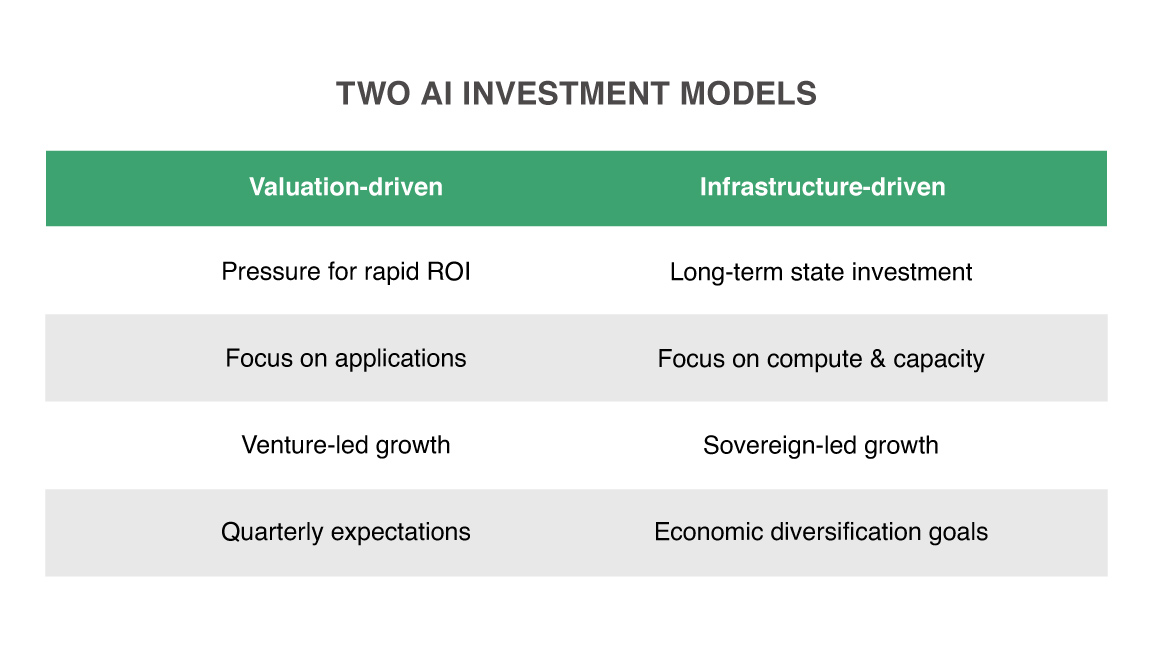
Mohanad Yakout, senior markets analyst at Scope Markets, says, “The Middle East is not immune to AI market cycles, but it is operating on a different timeline”. The distinction exists, acting subtly yet significantly. In Western markets, he says, “Bubble concerns are tied to public-company valuations and pressure to quickly monetize AI products.” In contrast, in the Middle East, he adds, “Investment is largely focused on building foundational infrastructure.” This difference in focus alters the risk profile of AI investment.
The region is known for investing heavily in hard infrastructure, such as data centers and AI labs, and for building talent pipelines. Ryaan Sharif, GCC Partner at F6 Ventures, points out that there’s still a shortage of experienced founders and teams ready to deliver results.
To address these gaps, Saudi Arabia and Oman are setting up large AI zones as part of their digital strategies. Partnerships between organizations such as Emirates Development Bank and MBZUAI are helping talent adapt to new AI workflows. The goal is to create real use cases that generate revenue and build a talent pool that isn’t just attracted by high salaries.
A key constraint is the relatively small role played by private capital and startups. According to geopolitical commentator Roozbeh Aliabadi, the prospect of sudden regulatory shifts can deter long-term investment by smaller firms. In Saudi Arabia, he notes, “less than 2% of AI funding reaches startups,” while most capital is channeled into large infrastructure programs. Although such investments can accelerate national AI ambitions, they may also limit the emergence of a broader innovation ecosystem driven by entrepreneurial experimentation.
The Maturing Nature of GCC Structures
As state-financed ecosystems accelerate, public markets and venture capitalists remain somewhat on the sidelines. Yakout says, “Many large projects are state-led and designed to support long-term economic transformation rather than near-term financial returns.” This means these investments are not pressured by quarterly earnings or short-term market swings, which helps reduce volatility. Even if some projects don’t perform well, the overall strategy is less likely to be dropped.
Yakout notes that governments and sovereign investors absorb short-term failures by restructuring or consolidating projects, rather than exiting the sector altogether. This creates a buffer against the boom-and-bust cycles typically associated with speculative bubbles.
Next comes the luxury to expand infrastructure. The Middle East has concentrated capital in physical and digital infrastructure from the state and some of the biggest foreign names. This includes megaprojects for data centers, cloud systems, and energy networks required to support AI workloads.
For instance, in May 2025, the G42-led Stargate was announced as one of the 10 OpenAI data centers outside the US. The project in Abu Dhabi is expected to cost over $30 billion. In Riyadh and Dammam, multiple joint ventures between Humain and other groups are underway to build a 1 GW data center and create an AI-ready computing environment. Similar initiatives at different scales have been spurred across the region through collaboration with global technology firms.
These investments are less speculative than betting on new applications. Building infrastructure takes longer, costs more, and usually has a more predictable demand. As global AI adoption grows, the need for computing power and data storage will increase, making returns more stable.
“The GCC will remain the primary center of capital and deployment, particularly in Saudi Arabia and the UAE.”
— Ryaan Sharif, GCC Partner at F6 Ventures
Yakout points out that a key sign of overheating is “whether AI spending is translating into real operational use and revenue.” In the Middle East, there are early signs that the public sector is on the right track. However, the Iran conflict could disrupt capital flows, as higher defense costs and the repair of damaged infrastructure stretch budgets.
He emphasizes that “the primary driver is market fundamentals,” particularly the region’s access to abundant capital and low-cost, reliable energy. As AI workloads become increasingly energy-intensive, these factors reduce operational costs and enhance competitiveness.
Technological investments are usually evaluated based on revenue growth, cost savings, and shareholder value. However, the criteria can be broader. Yakout says, in the region, returns are assessed in terms of “job creation, skills development, GDP growth, and long-term economic diversification.”
This broader view means that investments that aren’t immediately profitable can still make sense for strategic reasons. AI is seen as a national infrastructure, similar to transportation or energy.
Aliabadi cites an example from the Gulf aviation industry: major airlines in the region, such as Riyadh Air, Emirates, and Etihad, are all 100% backed by their regional governments, similar to the state-financed foundational AI ecosystems being laid.
These do not eliminate risk, but reduce the likelihood of a disconnect between capital deployment and economic value. Rebecca Patterson, a senior fellow at the Council on Foreign Relations, says, “War-related risk is much less obvious than rising gasoline or fertilizer prices for the United States. It has the potential, however, to be significant and damaging, which will grow the longer the Strait of Hormuz remains closed.”
Yakout emphasizes that a durable ecosystem will require “independent, recurring revenue from AI products and services,” particularly in sectors where AI can demonstrably improve productivity. Until this transition occurs, the long-term sustainability of current investment levels remains an open question. Sharif notes that, “The GCC will remain the primary center of capital and deployment, particularly Saudi Arabia and the UAE.”
Moving Beyond Pilots and Announcements
Organizations can draw valuable lessons and heed warnings from the approach taken in the Middle East. The key takeaway is that successful investment in AI requires a mature structure. While the war has slowed progress in the Gulf, AI is still growing rapidly behind the scenes.
At the executive level, this suggests a need to rethink capital allocation in light of the current economic climate. Local and diverse infrastructure and integration should continue to be prioritized to enable AI to function as part of the operating core, like data systems, compute capacity, and workflow redesign.
Boards, meanwhile, must adjust their monitoring of the governance frameworks to account for the long-term nature of AI investment. This includes redefining performance metrics, balancing short-term accountability with strategic patience, and ensuring that investments align with organizational and overall ecosystem objectives rather than just current market trends.
“Observers should track whether AI companies are moving beyond government-funded pilots and securing paying private-sector customers. A durable ecosystem will show an increasing number of sector-specific AI solutions, particularly in energy, healthcare, finance, and logistics, that demonstrably reduce costs or improve productivity. Sustained commercial adoption, not funding announcements, will indicate that the region has transitioned from a capital-driven build phase to a market-driven growth phase,” says Yakout.
Nearing The End of Speculative Growth
“We have an AI bubble. But as always, there will be companies that make it and those that don’t. Regardless of the type of investment we’re seeing, several companies are actually going to vanish,” says Aliabadi.
While the scale of the AI restructuring is currently difficult to gauge, experts agree that a correction is due. “The countries that treated AI as a trophy will get crushed. The ones that built real infrastructure, attracted real talent, and focused on unsexy fundamentals will survive,” notes Judah Taub, the founder and managing partner of Hetz Ventures.
What Leaders in Each Role Must Do Differently
C-Suite | AI competitiveness increasingly depends on operational infrastructure rather than experimental deployments alone. Leaders should evaluate whether their organizations are building AI into core operating systems — data, compute, workflows, and governance — or simply layering pilots onto legacy structures. The Gulf model also demonstrates that resilience may become as important as the speed of innovation in AI strategy. |
Operations Leaders | Technology, operations, and finance leaders will need to align AI investments with long-term capability building rather than short-term experimentation metrics. The next stage of AI maturity will likely reward organizations that can integrate AI into sector-specific workflows, redesign operating models, and measure outcomes across functions. |
Boards & | Boards should reassess how AI investments are evaluated and governed amid geopolitical and economic uncertainty. Governance leaders must balance strategic patience with accountability while ensuring organizations avoid speculative AI spending disconnected from operational value creation. |
RESEARCH CONTEXT
This article is grounded in interviews with regional investors, geopolitical analysts, market strategists, and AI ecosystem observers, as well as in research reports and public infrastructure announcements that are shaping the Middle East’s emerging AI economy.
The article also draws on:
- 2025 enterprise AI deployment findings from the MIT Media Lab’s NANDA initiative, particularly around the gap between AI spending and measurable ROI.
- Research and economic analysis from McKinsey & Company on GCC AI investments and organizational preparedness.
- Publicly announced regional infrastructure projects involving OpenAI, G42, and regional AI/data center initiatives in Saudi Arabia and the UAE.