
Saudi Arabia Unveils Fresh Guidelines to Regulate Deepfakes
The framework distinguishes between beneficial and malicious synthetic media while proposing safeguards for high-risk use cases.
News
- Ford Rehires 350 Engineers After Finding AI Alone Wasn't Enough
- $725 Billion Later, 91% Say Organizations Still Aren't Realizing AI's Full Value
- AI Dispatch | AI's Transformation Phase
- OPAQUE and TII Launch Open Standard for Verifiable AI Governance
- e& UAE Launches OneWork, a Unified Communications Platform Hosted Entirely in the UAE
- Alibaba Used 29 Million Fake Exchanges to Extract Claude's Intelligence, Claims Anthropic

The Saudi Data and Artificial Intelligence Authority (SDAIA) has released new deepfake governance guidelines to regulate the wave of synthetic media driven by generative AI tools.
Titled “Deepfakes Guidelines: Mitigating Risks While Fostering Innovation,” the framework updates an earlier guidance document issued in May last year. The document positions deepfakes not as an inherently harmful technology, but as a dual-use capability whose societal impact depends largely on intent, deployment context, and oversight mechanisms.
The guidelines define deepfakes as hyper-realistic synthetic media generated by deep learning systems such as generative adversarial networks, auto-encoders, and face-swap algorithms capable of manipulating audio, video, and digital imagery in ways increasingly difficult to detect.
Rather than framing the issue solely as risk, the document attempts to balance innovation incentives with regulatory safeguards. It identifies six sectors where synthetic media could have legitimate commercial and social value: marketing, entertainment, retail, education, healthcare, and cultural preservation. Examples cited include voice reconstruction technologies for ALS patients, AI-powered tutoring systems for underserved communities, digital preservation of endangered dialects, and consensual de-aging technologies in film production.
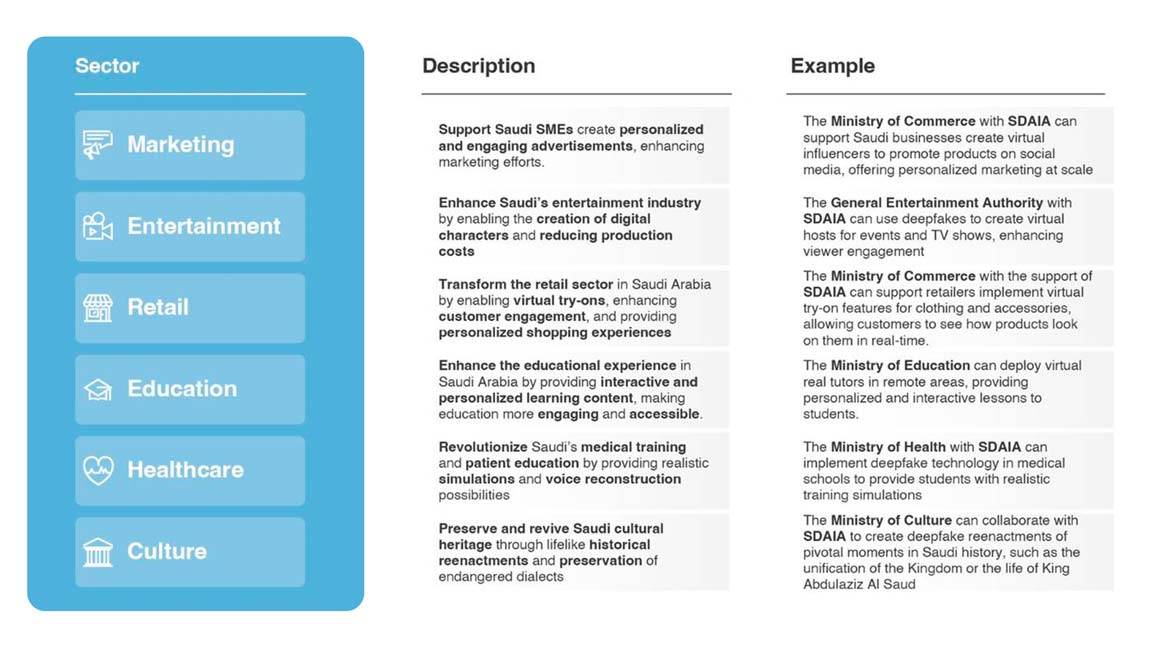
Image source: Arab News
At the same time, the authority warns that the malicious use of deepfakes is evolving rapidly, particularly in financial fraud, reputational manipulation, and political disinformation.
The first major risk category outlined is impostor scams. The document describes scenarios in which AI-generated voices and manipulated video feeds imitate trusted executives or public figures to authorize fraudulent transactions or extract confidential information. One cited example involves a multinational company employee transferring funds after being deceived during a video conference with fraudsters impersonating senior leadership.
A second area of concern is non-consensual manipulation, including the generation of explicit or compromising synthetic content without an individual’s approval. The guidelines note that such uses can result in reputational damage, emotional distress, and coercion through blackmail.
The third threat vector involves disinformation and propaganda. The authority warns that fabricated political speeches, interviews, and manipulated public statements could influence public opinion and destabilize democratic discourse, particularly as synthetic media becomes more difficult to distinguish from authentic content.
The report also points to an emerging phase of AI-enabled deception that extends beyond isolated fake clips. Future risks, it argues, may involve fully simulated virtual environments, fabricated meetings, synthetic news broadcasts, and near-perfect AI voice impersonation systems capable of deceiving users in real time.
To address these risks, the framework places significant compliance obligations on developers, creators, and regulators.
Developers are instructed to align systems with Saudi Arabia’s Personal Data Protection Law and Anti-Cyber Crime Law, while also considering international privacy standards. Recommended safeguards include privacy-by-design architectures, anonymization protocols, consent management systems, and mechanisms allowing individuals to request the removal of their likeness from AI training datasets.
The guidelines also call for embedded digital watermarking, documentation of model transparency, explainability mechanisms, and human oversight during model training and deployment. Developers are additionally encouraged to integrate automated detection systems capable of identifying unauthorized or unethical deepfake use.
For content creators, the framework mandates explicit consent procedures, auditable consent records, tamper-resistant watermarking, and secure distribution channels. The document further recommends blockchain-based provenance systems and cryptographic hashing to establish traceable records of original content and modifications.
Regulators, meanwhile, are advised to prioritize monitoring of high-risk sectors, including finance, politics, and identity verification, while applying lighter oversight to educational or lower-risk applications. The guidelines also recommend annual audits, public awareness campaigns, formal approval pathways for commercial deployment, and adoption of provenance standards developed by initiatives such as the Coalition for Content Provenance and Authenticity.