
The CEO Who Took Adobe to the Cloud Hands Over in the Age of AI
In an email to employees, Narayen said he would work closely with Calderoni and Adobe’s board to ensure a smooth leadership transition.
Topics
News
- AI Dispatch | AI's Transformation Phase
- OPAQUE and TII Launch Open Standard for Verifiable AI Governance
- e& UAE Launches OneWork, a Unified Communications Platform Hosted Entirely in the UAE
- Alibaba Used 29 Million Fake Exchanges to Extract Claude's Intelligence, Claims Anthropic
- Anthropic's Mythos Finds Critical Flaws in Classified US Systems: Report
- Qatar Launches AI-Focused Scholarship Program to Build Future Digital Workforce
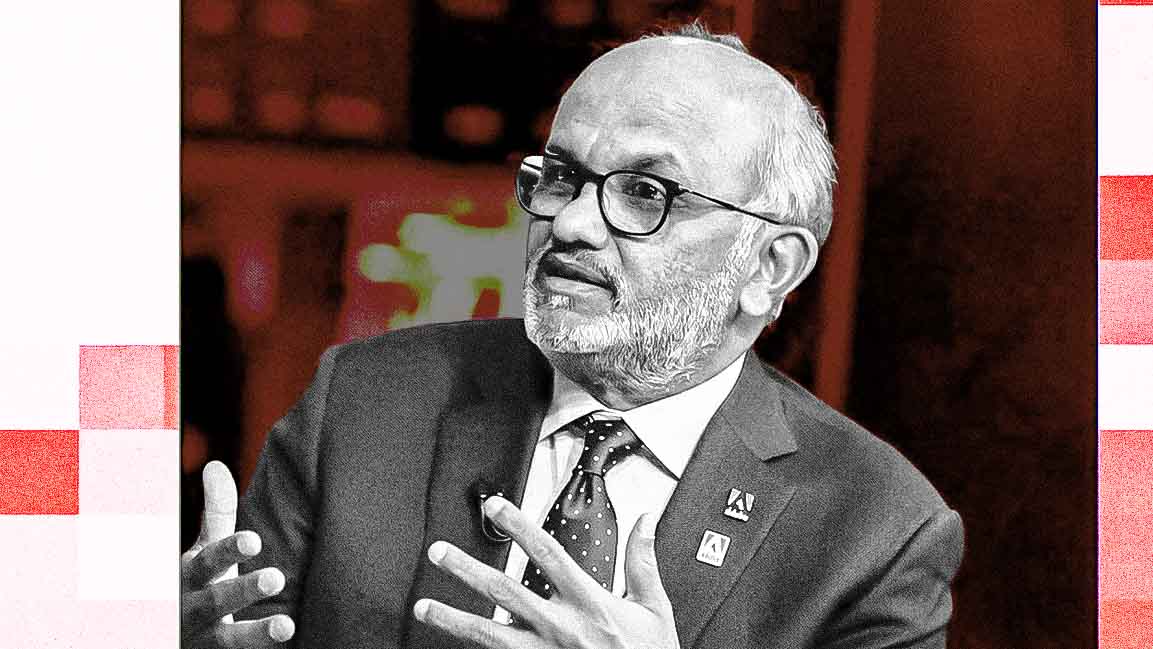
Shantanu Narayen, the long-time chief executive of Adobe, plans to step down after nearly two decades at the helm, the company announced on March 12, marking the end of one of the longest tenures among leaders of major global software firms.
Narayen, who has led the company for 18 years, will continue as CEO until a successor is appointed. After the transition, he will remain with the company as chairman of the board.
Adobe said its lead independent director, Frank Calderoni, will head a special committee to oversee the search process, which will consider both internal and external candidates.
In an email to employees, Narayen said he would work closely with Calderoni and Adobe’s board to ensure a smooth leadership transition.
“I will stay on as Chair of the Board to support the next CEO just as (Adobe co-founders) John Warnock and Charles Geschke did when I took on this role,” Narayen wrote.
Calderoni credited Narayen with reshaping the company during a period of major technological change. “On behalf of the board, I want to recognize Shantanu’s contributions as CEO and architect of Adobe’s transformation over the past 18 years, and for positioning Adobe for success in the AI-driven era,” he said.
The leadership transition comes at a time when Adobe is racing to embed artificial intelligence across its product portfolio while facing intense competition in the design software market.
In recent years, the company has integrated generative AI features across its creative tools, such as Adobe Photoshop, Adobe Acrobat, Adobe Premiere Pro, and Adobe Illustrator, as well as enterprise offerings under its Experience Cloud platform.
Adobe has also introduced its own family of generative AI models, Adobe Firefly, which are designed to generate images and videos while remaining commercially safe for professional use.
According to Narayen, annualised revenue from Adobe’s AI-first products more than tripled year-on-year in the first quarter of fiscal 2026, which ended on February 27.
“The next era of creativity is being written right now, shaped by AI, new workflows, and entirely new forms of expression,” Narayen told employees in his note. “Adobe has never waited for the future to arrive. We’ve anticipated it. We’ve built it. And we’ve led it.”
Narayen joined Adobe nearly 28 years ago and became CEO in 2007. During his tenure, the company shifted from selling boxed software to a subscription-based cloud model and expanded its reach across digital media, marketing, and enterprise software.
In his message to employees, Narayen reflected on the company’s growth during that period.
“When I joined Adobe, we had around 3,000 employees. Today we have more than 30,000 people delivering technology that touches billions of users,” he wrote. During the same period, Adobe’s revenue grew from under $1 billion to more than $25 billion.
He said Adobe’s mission to “empower everyone to create” represents an even larger opportunity in the AI era.
Narayen’s tenure also saw one of the most closely watched deals in the design software industry. In 2022, Adobe announced plans to acquire the collaborative design platform Figma for $20 billion, which would have been the largest takeover of a private software company.
However, the companies abandoned the deal in December 2023 after facing significant regulatory scrutiny in Europe and the United Kingdom.
Figma later went public in July 2025 in one of the year’s biggest technology IPOs on the New York Stock Exchange.
Following the news of Narayen’s planned transition, Figma co-founder Dylan Field wrote on X that he had “come to know and respect” Narayen as a leader and wished him well.
Satya Nadella, CEO of Microsoft, congratulated Narayen on what he described as a “legendary run at Adobe,” noting that he had built one of the world’s most influential software companies and expanded what was possible for creators and businesses.
“What has always stood out to me is the empathy you’ve brought to the creative process and the example you’ve set as a leader,” Nadella wrote in a post on X.